#113.20 - Sunday #26: Persephone
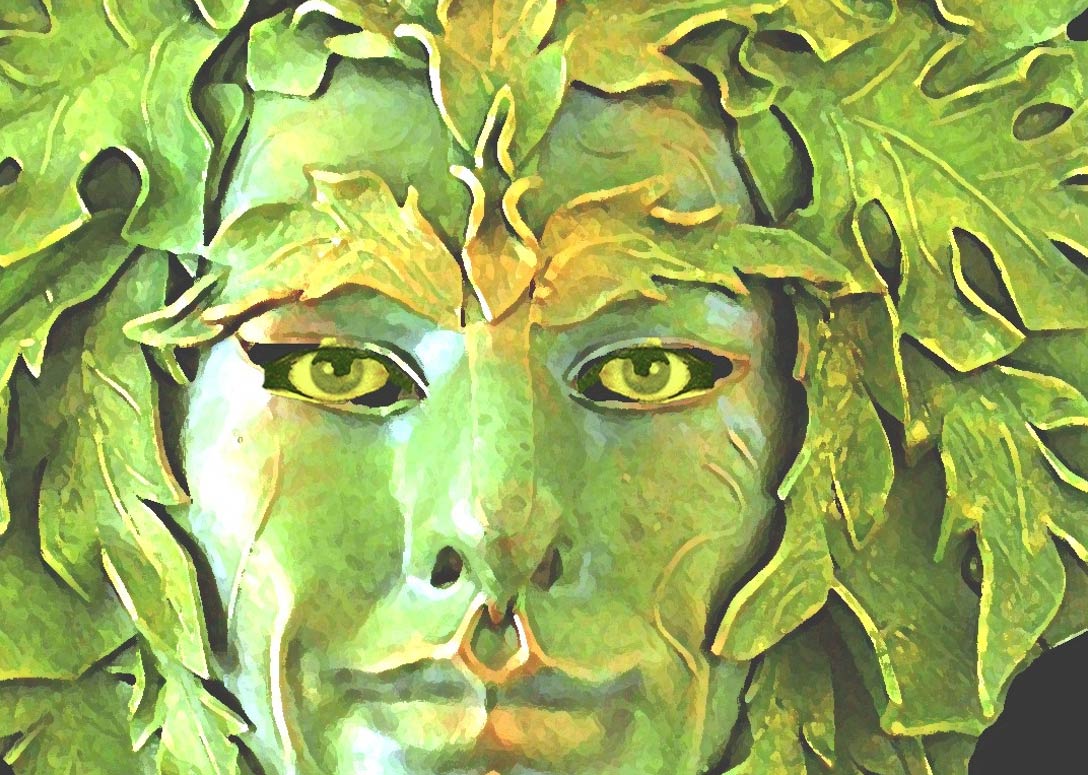 |
| Green Man - he who must be sacrificed to bring life |
Persephone is but one of the many cthonic deities which are unique in the Sumerian-Mesopotamian family of mythologies. These include Ishtar/Inanna/Eshkrigal, Adonis, Orpheus, Jesus Christ, Hermes, Mercury. They are also found in the Germanic-Nordic myths - such as Baldur and Odin. Although it is thought that these Northern deities were influenced by contact with the Christianity, especially the myth of Baldur.
The Sumerians later went on to influence the Semetic religions, then the Greeks and Egyptians, and eventually the cult of Christ. They, of course, were simply reflecting the seasons of death and decay - autumn and winter, and then the seasons of revival - spring. There was death, and then there was renewal. There was also sacrifice.
The Celtic myths - the myths of the British and Irish Isles practised human sacrifice - usually a man, who represented the bridegroom in the sacred marriage to the Earth, who was female. Just as a mother gestates the child, the Earth brought forth food. Just as the father impregnated the mother, the blood of the sacrifice enervated the Earth. This of course fitted in nicely with the Jesus myth, which is possibly why the Irish Druids so easily embraced Christianity. We often think of Patrick as an evangelical, but the Irish were converted within the space of a single generation in the 5th century, which is very quick, if you think about it, and it may be that Patrick had very good PR (although it has to be said there were others before him) or possibly, there were so many similarities between the religions that it was an easy transfer. Roman Catholicism was resisted by the Irish for a very long time, they held out with their brand of gentle, inclusive brand of Christianity, until it was Romanised, it has to be said, much later than the rest of Europe.
The idea that something had to die for it to come back to life - and while they did so in this other place between death and life, they went on a journey, began to apply to us when we died too. So, when people died, like the deities, in whose image we have always been made, even if it was a shittier version of the deities, we would be later be reborn - either in a place like Elysium/Heaven, the Duat, or return again. This return again probably began with the reincarnation myths of the Ancient Hindus. (You did not return again with the Sumerians - you died and that was it - as Gilgamesh found out.) But it was a powerful one. It was a myth with connected all life and it was holistic in the sense that you respected everything because you could come back as that thing.
Everything, of course, has a shadow, and somehow, human beings are predisposed to sliding towards shadow if we are left to our own devices. It is probably our most depressing quality - being unable to help ourselves. As a result, something like reincarnation. which was supposed to help us to reconnect this web of life, has resulted in the fucking caste system - where if you were good you are born a Brahmin and if you were bad, you were born an outcast and you deserved to be treated as an outcast because you were probably bad in a previous life and are now getting your just desserts.
Yes, we are crap that way, human beings.
Just like Easter, instead of being at time of renewal, it has become a time of chocolate - which begins as soon as Christmas ends.
But I digress. Persephone. Persephone is a Goddess - one of the oldest, as old as her mother. The Irish have the threefoldness of the Woman represented by Brigid, the Maiden, Danu/Cerridwen, the Mother and the Sheelanagig, the Crone. Persephone is the maiden - the beautiful corn that is planted, goes to sleep, awakens and then is harvested. In a clever slight of hand, trick of the light, her mother is Demeter - that which is eternal and is the force of life - who is both her mother, but as old as she is - both are ancient deities. Then there is Gaia, who is older than everyone, which is the Earth itself.
It is Persephone alone which journeys into the depths and then is reborn. Renewed. Because this journey is so awful, no one undertakes this willingly, so she has to be abducted. Her mother, Demeter is distraught, and ends up making the Earth barren so that Persephone is returned to her. But Hades has tricked her into eating the pomegranate seed while in the underworld, so she must return every year, to be Spring Maiden and Queen of the Dead.
It is a truly beautiful tale. A very elegant explanation for the seasons.
Except that it has a rape upon which the entire story pivots. Persophone being a woman is unusual in this mythic system. Even Mary holds the child Jesus, male, who is sacrificed to save us.
Let us look at the OTHER cthonic myths involving men. Osiris is tricked and murdered by his brother - not once, but twice. Adonis is gored by a boar. Orpheus willingly enters the Underworld to seek his wife. Inanna descends of her own free will to make peace with her sister who murders her. Jesus Christ is nailed to a cross as he carries out his Father's will. The Green Man must die in sacrifice to the Goddess.
In every instance death is involved. There is no running from this. Somehow we must go through the eye of the needle to get through to the other side.
Only with Persephone, there is the implication she has to surrender her agency in her sexuality - even though there is NO indication that she is ever sexually violated by Hades. They don't even have children and if they do have children in some stories, these children can be attributed to other parents. Persephone is a Sita character - she is abducted, but she never succumbs - except for the pomegranate seeds which she is tricked into eating.
Persephone reemerges, she brings with her all of creation. We are once again celebrating life, with the sadness that we will one day die. But it has been at some expense. The implication is that she has not died like the other vegtal gods - she alone has endured an unspeakable violation, of which, we will never discuss, but accept, over and over again, without opposition, without saying a single word.


Comments